

Show, Don’t Tell

One of the most vital skills a writer can learn is the art of showing instead of telling. It’s a confusing concept. How can you avoid telling someone something when words are the only tool you have?
The easiest way to understand this concept is to remember that your words are your paintbrush. When you write, you are trying to paint a picture in your readers’ minds. You want them to be able to picture the horseback riding lesson your main character is hosting or the tea party your antagonist just got invited to. More than that, you want to invite your reader to enjoy your painting with all of their senses. Your story should have a smell, a taste, a texture… and believe it or not, your words are powerful enough to give the story those traits.
But how?
First, you decide what it is you want your readers to know, then you describe that concept without ever stating it directly.
Say you are writing a scene in which a break up just occurred. Your main character, Blake, just broke up with her long term boyfriend, Michael. Blake is heartbroken but is trying to make it seem like she doesn’t care. Michael notices she’s lying about not missing him and calls her out.
You could write it like this:
Blake stared at Michael, adamantly refusing to let him know just how much this moment broke her heart. Michael gazed back and smiled sadly, a humorous but distraught laugh escaping his lips.
“If you want to break up, fine,” he said, “But at least have the decency to admit you do still love me instead of acting like none of it ever mattered. You can’t lie to me, Blake. Not like that.”
Your readers get the information you wanted them to know just fine. But even though we know how Blake is feeling, we can’t feel it ourselves. One of the most powerful aspects of writing is that it gives readers the chance to see inside of the characters’ heads and feel their emotions themselves. So in order to be strong writers, we need to utilize this effectively.
So let’s try “showing” the readers what Blake is feeling rather than just saying it:
Blake stared at Michael, her fists clenched so tightly her nails dug into her palms. She focused on the sharp pain of the indents as a distraction—she wouldn’t let herself cry no matter how much she wanted to, not until Michael left. Not until he couldn’t see her anymore. Michael gazed back, eyes flickering across her face and settling on her fists. A broken laugh escaped his lips as soon as he spotted the tension.
“If you want to break up, fine,” he said, “But at least have the decency to admit you do still love me instead of acting like none of it ever mattered. You can’t lie to me, Blake. Not like that.”
Now we see in our mind’s eye how Blake looks, and more than that, we see the tell that Michael noticed. We feel just how much this moment affects Blake. This is showing instead of telling.
Some other examples of showing vs telling are below:
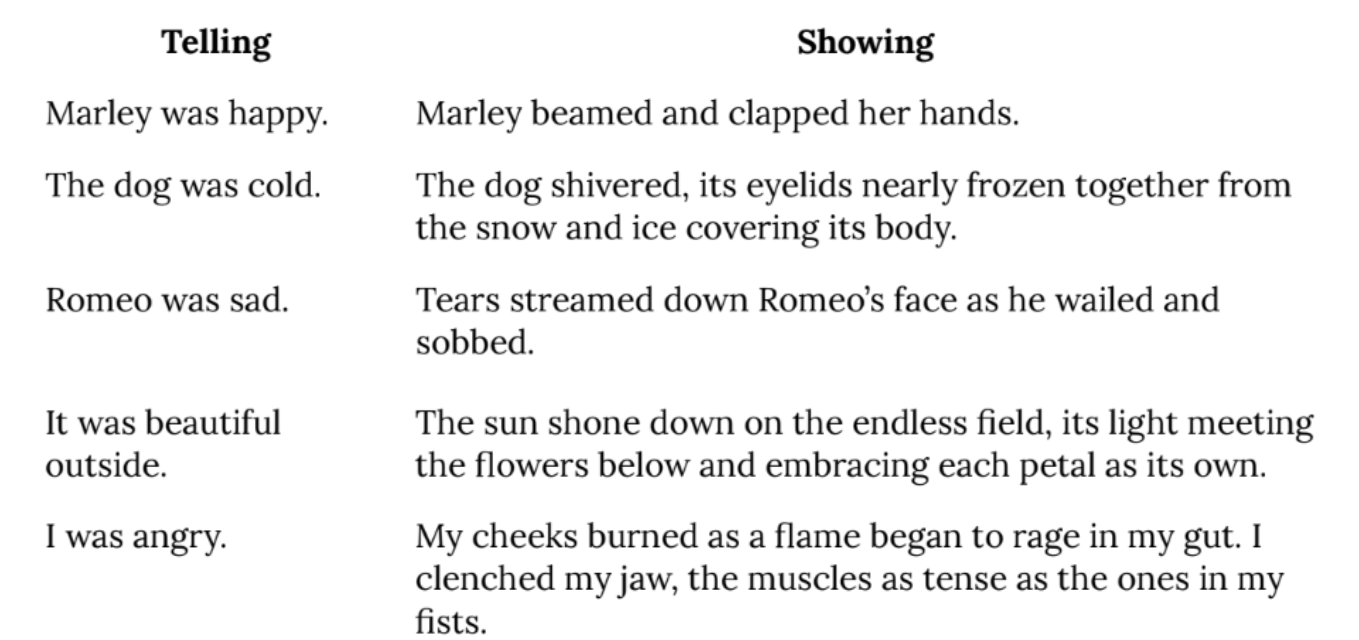
But how do I know when to show and when to tell?
Something you might have noticed about the example above is that showing takes many more words than telling does—in the case of Blake and Michael, 32 words vs 75 words. If you were to show every single part of your story, then you would be writing way more than necessary. One of the most important skills to have in writing is to know when to show and when to tell.
Telling, on the other hand, helps move the story along for less emotionally impactful portions. If your character needs to leave school and arrive at home, you don’t need to show every step they take and describe the snow crunching under their boots—you can just say “They left the school and within 15 minutes, they were home.”
Now, if something important happens on that walk home, such as a significant conversation on the phone or they see a friend on the way, then you can slow down and return to showing. But if all that happens is they go home, there’s absolutely nothing wrong with telling.
Practice
Exercise 1
Rewrite the following sentences so they are “showing” rather than “telling.”
Amanda was exhausted from studying for so long.
The cat was energetic.
Farah was angry at her sister.
Luke felt sick.
Devon was excited for the amusement park.
It was stormy outside.
Exercise 2
Choose whether the following scenarios should be mostly “shown” or “told.” Then, try and explain why.
These are a matter of opinion and there is no right or wrong answer. What’s important here is your reasoning.
Alice is writing a novel about a firefighter who gets lost in the woods. In the beginning of the story, he calls his wife to tell her he is going camping for a week. He’ll get lost there, but he doesn’t know that yet. This will be his final interaction with his wife until she finds and saves him at the end of the story. Should the phone call be mostly “shown” or “told”? Why?
Antonio is writing a short story about a ballerina who falls in love with a pilot. The pilot is practicing confessing his love to the ballerina by rehearsing with his friend, but the ballerina accidentally overhears him and thinks he’s in love with his friend instead. She’s heartbroken. This will lead to her trying to leave the city, and he will eventually stop her by confessing his love for real at the climax of the story. Should that practice confession with his friend be mostly “shown” or “told”? Why?
Klaus’ story centers around two friends who grow up together but, in adulthood, become enemies when they join opposite sides of a war. One of the friends is a prankster. When they are children, that friend tries to convince the other to help them prank their teacher. The friend says no. Should this argument be mostly “shown” or “told”? Why?